Trust Born Through Transparency

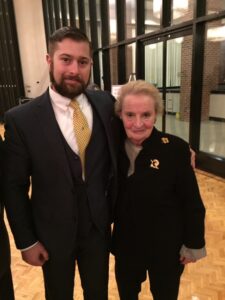 Britton Bouchard β€˜17 recently found himself grappling with weighty questions surrounding diversity, representation and effectiveness in America’s armed services when he participated in the 67 th Student Conference on U.S. Affairs (SCUSA) at the U.S. Military Academy in West Point, New York.
A political science major from Memphis, New York, Bouchard is the third ΊΪΑΟΙη student to attend the prestigious conference in as many years. The theme of this year’s event was β€œConfronting Inequality: Wealth, Rights and Power.β€ Its aim was to facilitate a constructive dialogue between civilian student delegates and West Point cadets in order to better understand the challenges that the nation faces in an increasingly interconnected world. The participants broke up into small groups to address a variety of issues, including global economic inequality, climate change, and democratization, and to consider how inequality, in all its forms, impacts U.S. foreign policy. They then drafted a paper with specific policy suggestions related to their area of focus, which they presented to leaders at West Point.
A Marine Corps veteran who was stationed in Okinawa, Japan, Bouchard was assigned to the group that reflected on civil-military relations. Overall in their paper they found that the current U.S. military is not representative of society, either demographically or geographically. However, they concluded that β€œas more attention is paid to the budget and size of America’s military, and the employment of America’s military abroad is scrutinized, Americans can decide the composition and fate of the military, and what civil-military relations becomes in the next era.β€ There is an opportunity for civilian and military officials β€œto bridge any civil- military gaps that exist now or may emerge in the near future.
β€œTrust comes from transparency and moral, ethical behavior,β€ Bouchard said. β€œOne of the things that we talked about is the importance of civilian oversight of the military. It’s important, in any profession, to have a second set of eyes. It promotes both communication and understanding.β€
Throughout the four-day conference, Bouchard said that he was struck by the sheer history of the 213-year-old institution, whose graduates include Dwight Eisenhower, Douglas McArthur, and Ulysses S. Grant. As a veteran, he had the opportunity to meet and have lunch with former Secretary of State Madeline Albright, who delivered the keynote address on civic engagement. Bouchard recalled that in their conversation Secretary Albright noted the particularly important role the Marines play is U.S. foreign policy as they provide the security for America’s embassies.
Bouchard said that he will carry the lessons he learned during the conference, particularly as they relate to equality and power, with him throughout his professional life. After he
graduates from ΊΪΑΟΙη, Bouchard plans to become an attorney and to specialize in advocating for abused children. β€œUnfortunately, people most in need of legal coverage and protection are those who receive it the least,’ he said.
He stressed, though, that he left the conference not feeling overwhelmed by the challenges facing the world today, but inspired by the opportunities before it. I was floored by the talent I saw there. There was so much potential and intelligence. It made me feel very confident about the future.β€