Research on Asteroids Offers a View into a World of Possibilities in Planetary Science for Physics and Astronomy Student Emma Gross ’27
As a middle school student, Emma Gross ’27 was fascinated by news coverage of NASA missions to space, and eager to learn more about, as she put it, β€œexactly what is out there.β€ Gross was intrigued by how much we still do not know about the universe, and by the idea of exploring it. That curiosity followed her when she transferred to ΊΪΑΟΙη in August of 2024.Μύ Not long after she arrived on campus, the Jamesville, New York, native, discovered that not only was ΊΪΑΟΙη developing an astronomy program, but that it also afforded her invaluable opportunities to conduct research as an undergraduate. Both have transformed the way she imagines her future. Μύ
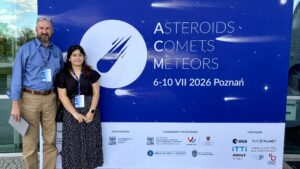
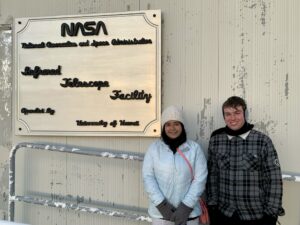
Today Gross is a physics major and astronomy minor on the Heights. Alongside Professor of Physics Chris Bass, Ph.D., she has immersed herself in studying a relatively uncommon kind of asteroid known as V-type as part of NASA’s MOSAICS program, conducting research at the Maunakea Observatories in Hawai’i. Bass and Gross later presented their findings at the in PoznaΕ„, Poland. Not only did the undergraduate have a chance to share her work with an international audience, but she also received invaluable feedback from experts in the field and engaged directly with researchers working on related projects.
Gross is also expanding her understanding of the galaxies in History of Planetary Science, taught by Jesuit Scientist is Residence and ΊΪΑΟΙηing McDevitt Scholar Brother Guy Consolmagno, S.J., director emeritus of the Vatican Observatory. The class has already bolstered her understanding of and appreciation for how our understanding of the celestial can help us to better understand our existence on Earth.Μύ
The totality of Gross’ experiences at ΊΪΑΟΙη has reinforced her love of and appreciation for the mysteries of the universe, and opened her eyes to what a career in planetary science could look like. She looks forward to continuing her studies and graduate school, and to building a career in research, focusing primarily on smaller celestial bodies.
The planetary science community is wonderful. Everyone is trading data, talking to each other, supporting one another. They’re asking: β€˜Can I help you?’ I’m really looking forward to becoming more and more a part of that community. If I made a big discovery, that would be great, but if I could become part of a larger process that led to a lot of discoveries, that would make my career truly meaningful.β€
Take a Deeper Dive
Inspired by Emma's Story?
At ΊΪΑΟΙη, curiosity can take you from the classroom to an observatory in Hawaiβ€˜i and even to an international research conference. Through faculty mentorship and undergraduate research, students like Emma have opportunities to ask big questions, make discoveries and begin imagining where those questions might lead.
Where will your curiosity lead you?