Professor Bass and Emma Gross ’27 Present at the Asteroids, Comets and Meteors Conference in Poland
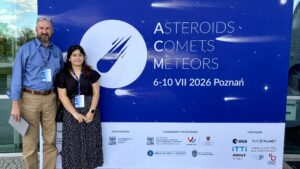
Emma Gross ’27 and Christopher Bass, Ph.D., chair of ΊΪΑΟΙη’s physics department, made presentations at the in PoznaΕ„, Poland in June 2026. The conference is an international scientific meeting that brings together researchers studying small bodies throughout the Solar System, with researchers from universities, observatories, space agencies and research institutes attending to present new findings and discuss ongoing research.
β€œOur project focuses on V-type asteroids, a relatively rare class of asteroids believed to be fragments of larger bodies that experienced extensive heating and melting early in the Solar System’s history,β€ said Bass. β€œBy studying their composition, scientists can gain insight into the processes that shaped the rocky planets and other planetary building blocks more than 4.5 billion years ago. We are using data from the European Space Agency’s Gaia mission together with follow-up observations obtained at NASA’s Infrared Telescope Facility in Hawai’i to better understand these objects.β€ The project includes collaboration with Dr. Driss Takir of the Space Science Institute, a planetary scientist whose expertise in asteroid spectroscopy has helped guide the research. Their participation was supported by the College’s NASA MOSAICS grant.
At the conference, Bass presented β€œNear-Infrared Spectroscopic Follow-Up of Gaia DR3 V-Type Asteroid Candidates with IRTF/SpeXβ€ detailing his ongoing asteroid spectroscopy research, and Emma, a physics major and astrophysics minor, presented a poster highlighting her contributions to the data analysis aspects of the project. Her poster presentation was titled β€œPreliminary Near-Infrared Spectral Analysis of the Gaia V-Type Asteroids (1904) Massevitch and (1914) Hartbeespoortdam.”
Bass noted that one of the goals of the NASA MOSAICS grant is to help establish a sustainable astronomy research program at ΊΪΑΟΙη that provides undergraduate students with opportunities to participate in authentic scientific research. β€œAttending ACM gave Emma the opportunity to present her own research findings to an international audience, receive feedback from experts in the field and engage directly with researchers working on related projects,β€ he said.